Welcome to Magnet Energy
  • Home
  • About us
  • PM history
  • REPM history
  • The applications
  • Demagnetizing Factor
  • Magnetics Calculator
  • Magnetics basics
  • Magnet types
  • Contact us
  • Feedback
  • Posts

Toyota Central R&D developing free-piston engine linear generator; envisioning multi-FPEG units for electric drive vehicles

April 28, 2014


http://www.greencarcongress.com/2014/04/20140422-fpeg.html

22 April 2014
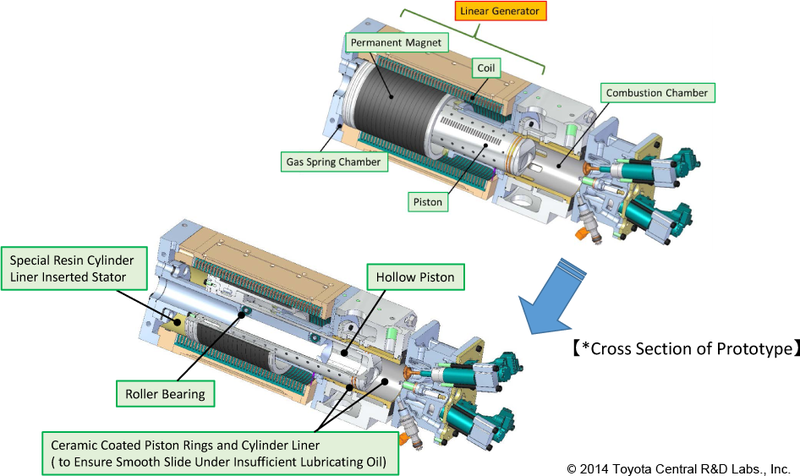
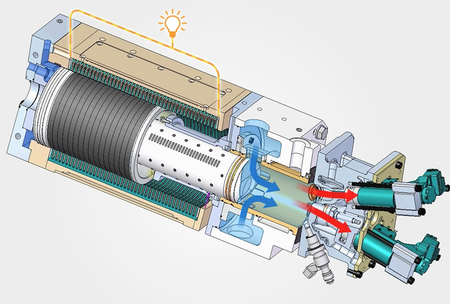
Toyota’s FPEG features a hollow step-shaped piston, combustion chamber and gas spring chamber. Click to enlarge.A team at Toyota Central R&D Labs Inc. is developing a prototype 10 kW Free Piston Engine Linear Generator (FPEG) featuring a thin and compact build, high efficiency and high fuel flexibility. Toyota envisions that a pair of such units (20 kW) would enable B/C-segment electric drive vehicles to cruise at 120 km/h (75 mph). The team presented two papers on the state of their work at the recent SAE 2014 World Congress in Detroit.
Picture

Toyota’s FPEG features a hollow step-shaped piston, combustion chamber and gas spring chamber. 
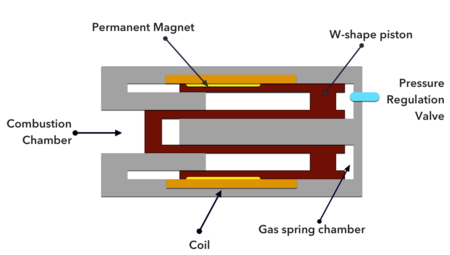
The FPEG consists of a two-stroke combustion chamber, a linear generator and a gas spring chamber. The piston is moved by the combustion gas, while magnets attached to the piston move within a linear coil, thereby converting kinetic energy to electrical energy. The main structural feature of the Toyota FPEG is a hollow circular step-shaped piston, which Toyota calls “W-shape”. The smaller-diameter side of the piston constitutes a combustion chamber, and the larger-diameter side constitutes a gas spring chamber.

Picture

FPEGs are attractive for a number of reasons, the Toyota researchers note, including thermal efficiency, low friction, and low vibration. Two basic design approaches have emerged: the first is a structure with two opposed combustion chambers; the second, a structure with one combustion chamber and one gas spring chamber. In the latter approach, the gas spring chamber is responsible for returning the piston for the subsequent combustion event. This second configuration is the one selected by Toyota for further investigation by both numerical simulation and experimentation.

The Toyota FPEG is based on a double piston system; at one end is the combustion chamber, and at the other, the adjustable gas spring chamber. Burned gas is scavenged out through exhaust valves mounted in the cylinder head of the combustion chamber; fresh air is brought in through the scavenging port at the side wall of the cylinder liner.

A portion of the kinetic energy of the piston is stored in the gas spring, and extracted on the return stroke to the combustion chamber side. A magnetic “mover” is mounted at the outer periphery of the piston; the mover and the stator coils together comprise the linear generator component of the FPEG.
Picture

The “W-shape” piston design offers several advantages, Toyota says:

  • The larger cross-sectional area of the gas spring chamber leads to lower compression temperature of the gas spring chamber and consequently decreased heat loss.
  • The piston has a hollow structure and moves along a column stay, which in turn enables the construction of a cooling oil passage within the stay. The key technologies to deliver stable continuous operation of an FPEG are lubricating, cooling, and control logic. (The Toyota team’s second paper deals exclusively with the control system.)
  • The inner periphery of the hollow piston also serves as a sliding surface on the column stay, enabling a steady small clearance between the magnets and coil for improved generating efficiency.
  • The magnet is set far from the piston top, preventing magnet degaussing by heating.

The researchers developed a one-dimensional cycle simulation to investigate the performance of the proposed structure, and used it to assess spark ignition combustion (SI) and premixed charged compression ignition combustion (PCCI). They achieved output power of 10 kW with both SI and PCCI combustion cases; the PCCI combustion case realized 42% thermal efficiency.

They then constructed an FPEG prototype with a uni-flow scavenging type, two-stroke SI combustion system as an experimental study. They used ceramic-coated piston rings and cylinder liner they developed in order to ensure the smooth sliding of the piston even under insufficient lubrication. Poppet valves seated in a water-cooled cylinder head were actuated by hydraulic valve trains to control exhaust valve timing. Direct injection reduced unburned hydrocarbon emissions exhausted through the scavenging process.

A pressure regulating valve in the gas spring chamber enabled a variable gas mass, thereby varying the stiffness of the gas springs—one of the variables to shift the FPEG to different operating points.

The linear generator was a permanently excited synchronous machine consisting of the stationary coil, the mover (based on neodymium-iron-boron magnets) attached to the piston, and iron-cored stator. The poer electronics drive the machine as both a motor and a generator.

The researchers designed the prototype control system to ensure that the compression ratio was kept to the values which enable stable combustions—i.e., the generating load coefficient is variable, not constant. The coefficient is determined by a feedback control method based on the postion and velocity of the piston.

As there is no crank mechanism, the piston position in an FPEG is not defined with crank angle. However, knowing the piston position is critical not only to timings (fuel injection, ignition, opening/closing exhaust valves), but also to mode selections of driving or generating. To determine piston position, the Toyota researchers count plural-lines grooves engraved on the side surface of the piston body with gap sensors fixed on the inner wall of the cylinder block. (The detailed method of detecting and controlling piston position is the subject of the second paper.)

The generator control logic must meet the following requirements, according to the researchers:

  • Assuming a multi-unit vehicle application, the multiple FPEGs would cancel out vibration through a horizontally opposed layout; the frequency and phase of the piston oscillation should be controllable.
  • TDC and BDC need to be precisely controlled for stabilizing two-stroke combustion.
  • After knocking or misfire, the oscillation must continue robustly.

The prototype FPEG with W-shape piston and two-stroke SI combustion system achieved stable operation for more than 4 hours without any cooling and lubricating problems.

The experimental analysis also showed that the precise control of ignition position is essential for stable operation of the FPEG.

In future work, the research team plans to improve the power generation of the system and to perform a quantitative analysis of the efficiency.

Resources

  • Kosaka, H., Akita, T., Moriya, K., Goto, S. et al. (2014) “Development of Free Piston Engine Linear Generator System Part 1 – Investigation of Fundamental Characteristics,” SAE Technical Paper 2014-01-1203 doi:10.4271/2014-01-1203
  • Goto, S., Moriya, K., Kosaka, H., Akita, T. et al. (2014) “Development of Free Piston Engine Linear Generator System Part 2 – Investigation of Control System for Generator,” SAE Technical Paper 2014-01-1193 doi:10.4271/2014-01-1193
2014 International Conference on NdFeB Magnets

March 6, 2014

 
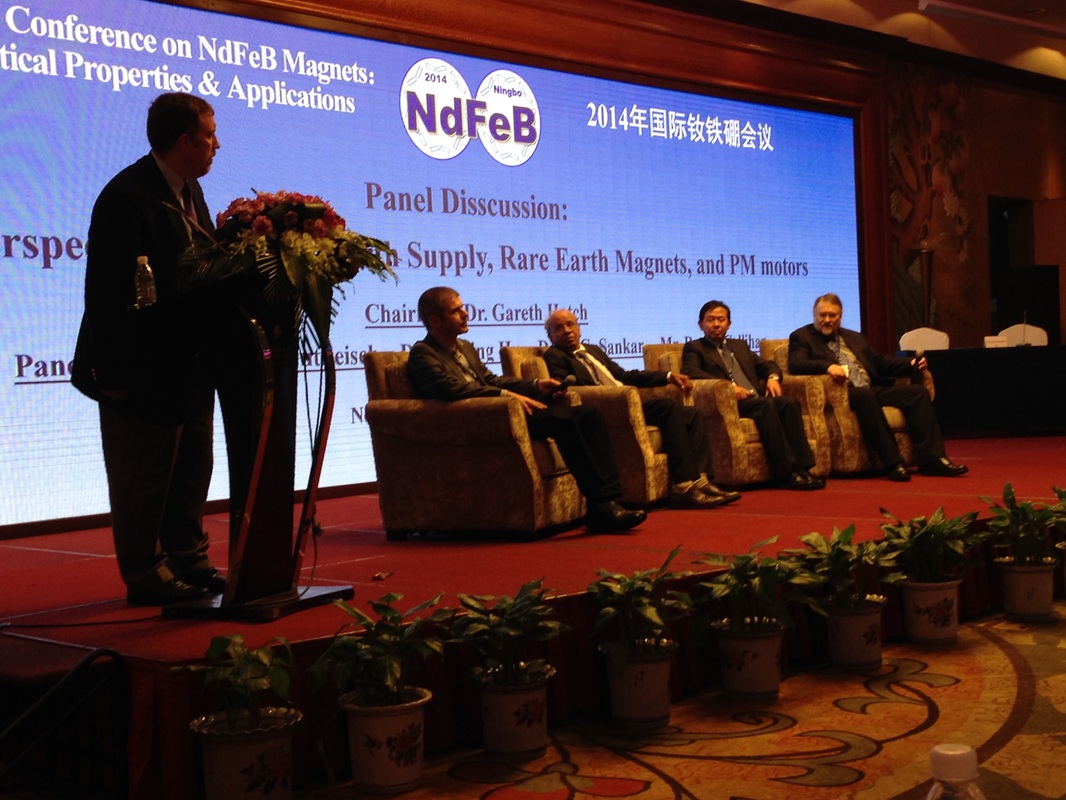
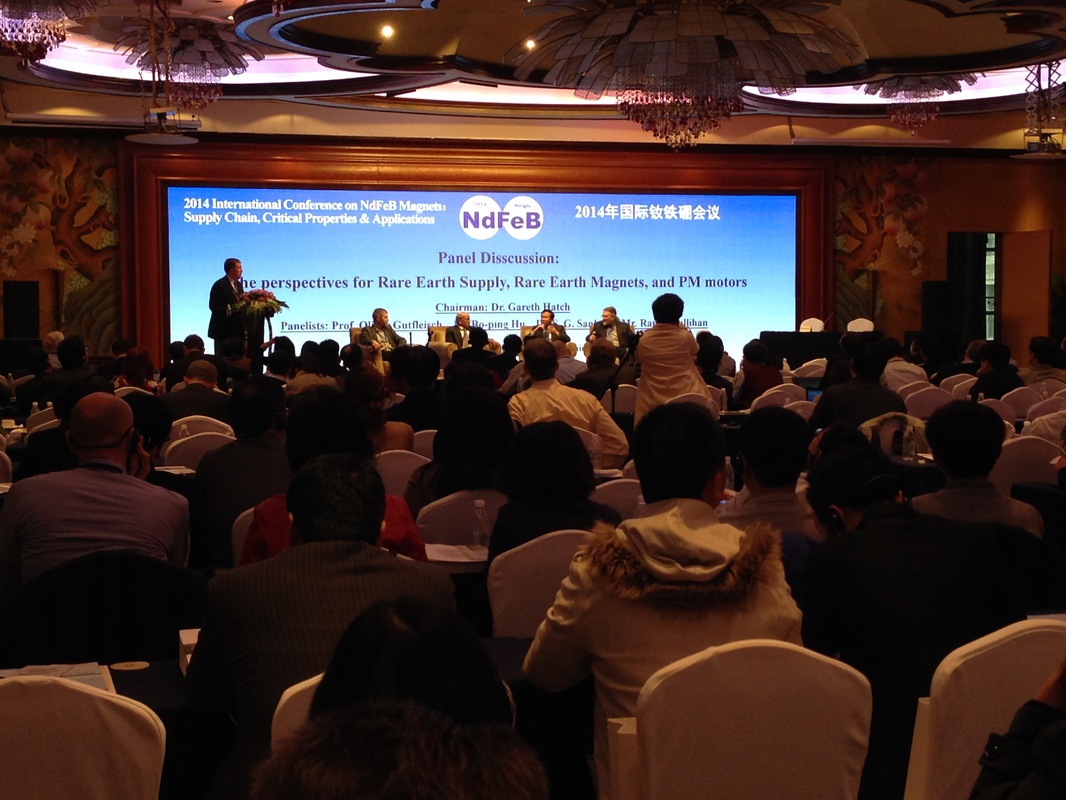
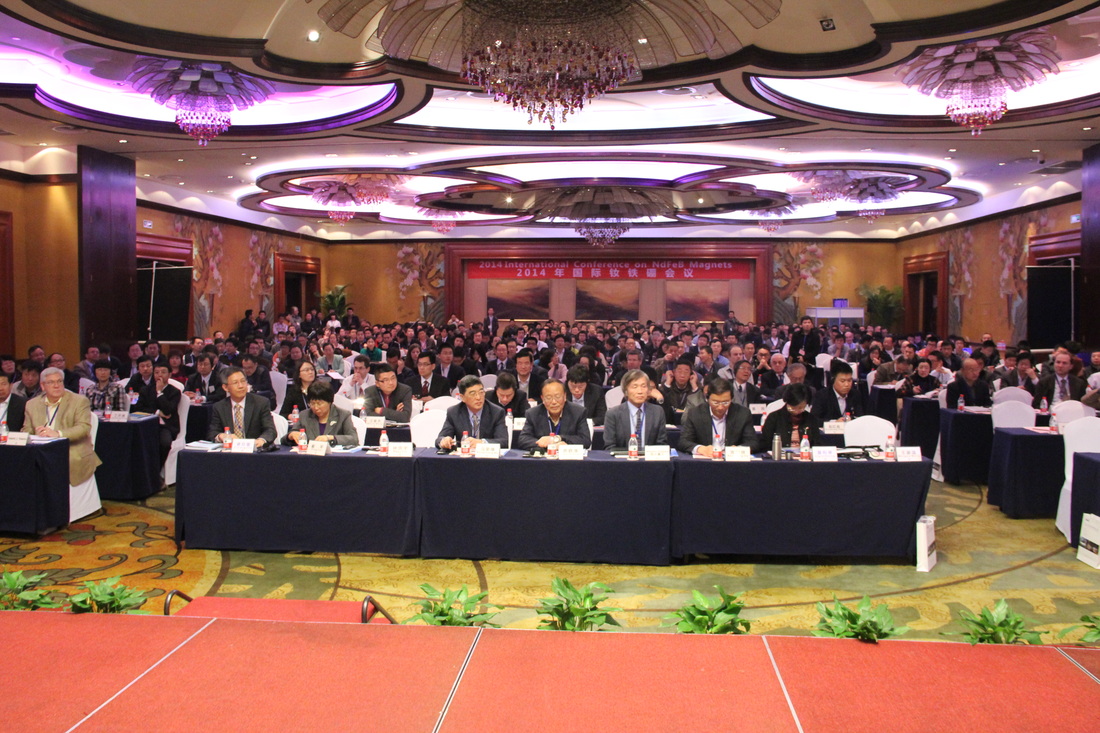
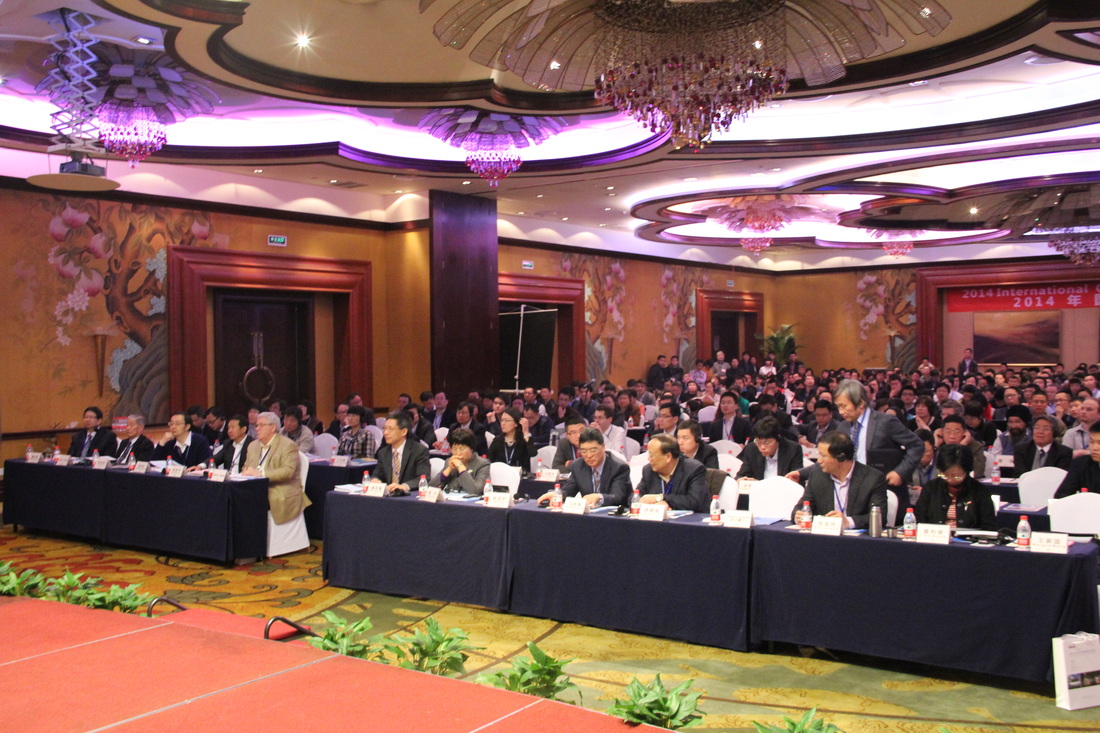
2014 International Conference on NdFeB Magnets: Supply Chain, Critical Properties, & Applications was successfully held in Ningbo, China on March 2nd – 5th, 2014. About 450 attendees in the field of rare earth metals and NdFeB & other magnetic materials, and PM motors from 18 countries attended the conference.

Picture

Picture

Picture

Picture

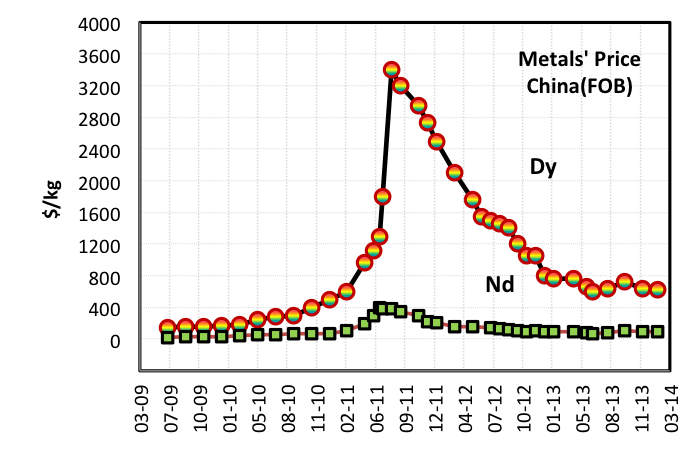
Rare earth metals’ prices stay at the same level May 2013                              Check out the prices for Neodymium and Dysprosium in Jan 2014:  http://www.metal-pages.com/metals/dysprosium/metal-prices-news-information/

January 23, 2014


Picture

The 58th MMM

November 11, 2013


Picture

The 58th Annual Magnetism and Magnetic Materials (MMM) Conference was  held in Downtown Denver, Colorado on Nov. 4 through Nov. 8, 2013

Association of China Rare Earth Industry and other organizations have Joined to host the 2014 International Conference on NdFeB:     http://www.ndfebpm.com/

October 29, 2013


Picture

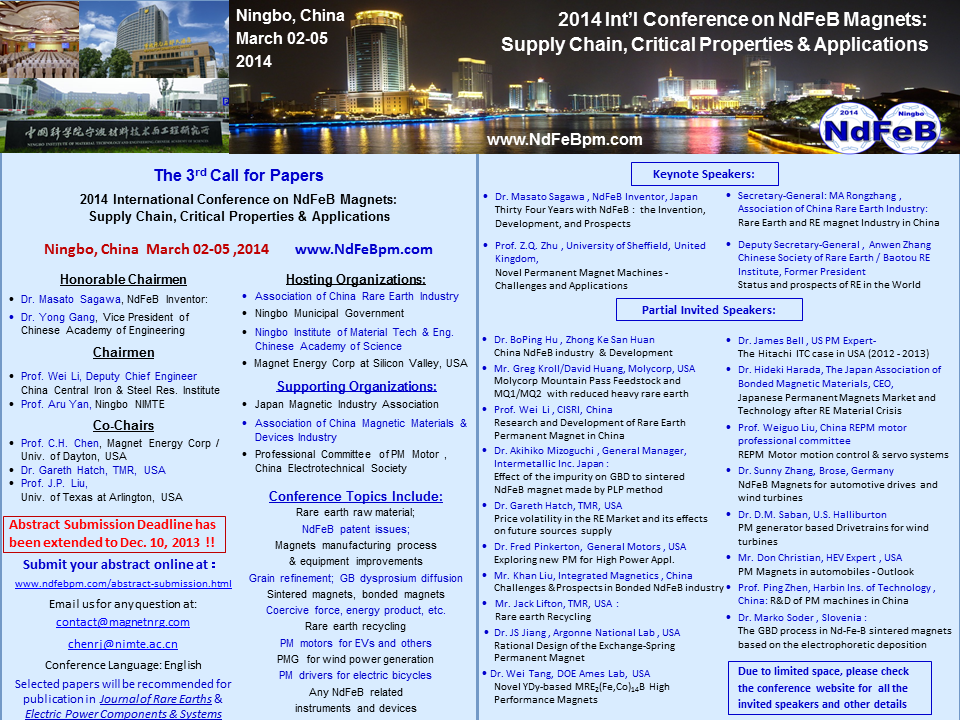
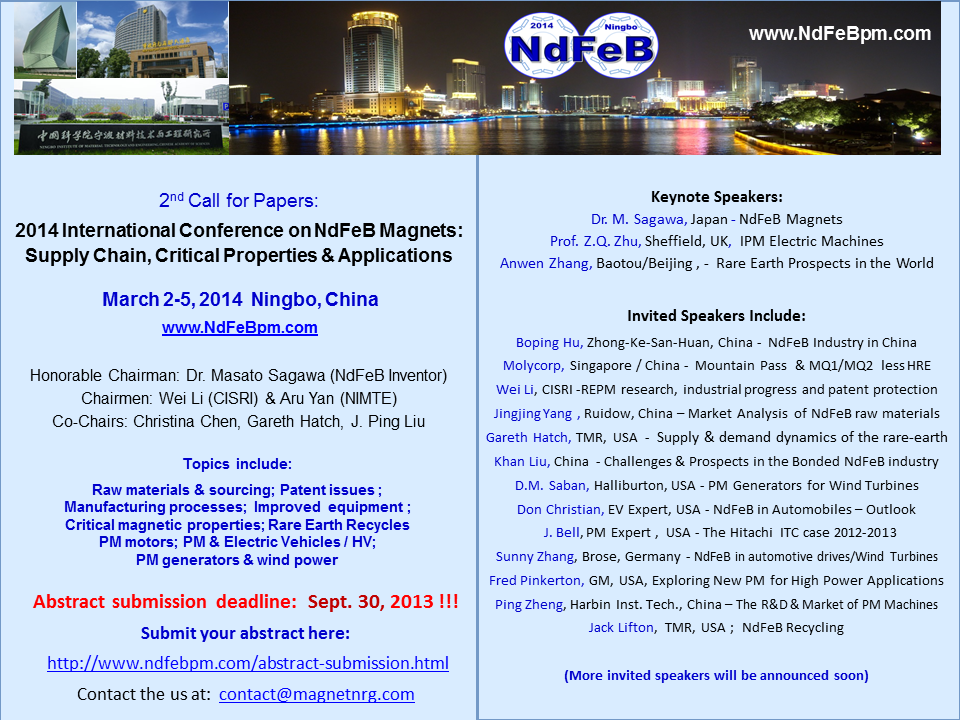
2nd Call for Paper: 2014 Int’l Conference: NdFeB Supply Chain, Critical Properties & Applications

August 21, 2013


We are pleased to invite you to submit your papers to 2014 International Conference on NdFeB Magnets: Supply Chain, Critical Properties & Applications, which will be held on March 2-5, 2014 in Ningbo, China.
Please read the details at  http://www.ndfebpm.com/ .
The deadline for Abstract Submission is Sept. 30, 2013. Please read the 2nd Call for Papers at: http://www.ndfebpm.com/2nd-call-for-paper.html.

This conference will provide a forum for exchanging the information of challenges and prospects in rare earth supply chain, the NdFeB industry, and the PM motors/ PM generators.

The NdFeB Inventor Dr. Sagawa is the Honorable Chairman of the conference and a Keynote Speaker, who will deliver a speech about the new development of NdFeB. 

Prof. Z.Q. Zhu, who is the Head of Electrical Machines Group from University of Sheffield, UK will give another Keynote Speech on the NdFeB applications in EV & wind power.

The former President of Baotou Rare Earth Institute, current Deputy Secretary-General of Chinese Rare Earth Society Prof. Anwen Zhang will deliver a Keynote Speech on the prospects of rare earth in China and around the world.

The conference will also have 12+ invited speakers, covering all the aspects of NdFeB related topics. Please check the website for details: http://www.ndfebpm.com/keynote–invited-speakers.html

Picture

The Switch Wins Prokon, China Wind Generator Orders

June 19, 2013


The Switch Drive Systems Oy, a Finnish supplier of generators, won more than 100 million euros ($134 million) of orders from German wind-farm operator Prokon Group and customers in China.
Prokon on June 17 agreed to buy 100 3-megawatt direct-drive permanent magnet generators and full-power converters, The Switch said in a statement. Combined with “significant” sales in China, the Vantaa-based company said orders in June totaled more than 100 million euros, creating a record backlog.

(Read more)

Hitachi Metals Files a Motion to Terminate ITC Investigation

June 6, 2013


Tokyo, Japan – Hitachi Metals, Ltd. announced today that it has filed a Motion to Terminate the Investigation on the Basis of Withdrawal of the Complaint with respect to the investigation pending before the United States International Trade Commission (ITC) regarding infringement of certain Hitachi Metals U.S. patents by the sale into the United States of certain sintered Nd-Fe-B magnets.
(Click to read the details)

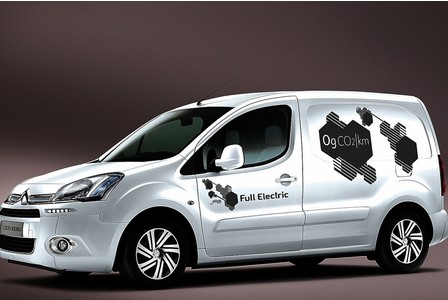
All-electric with Citroen: Permanent magnet synchronous electric motor

May 31, 2013


Picture

Read more:
The Berlingo Electric does away with the usual diesel engine and instead features a combination of permanent magnet synchronous 49kW electric motor and a 22.5kWh lithium ion battery pack. This gives the Berlingo Electric the potential for up to 106 miles, as tested on the New European Drive Cycle although in real terms you’re probably looking at around 70 miles reliably.
http://www.thisisnottingham.co.uk/electric-Citroen/story-19145703-detail/story.html#ixzz2UvCWWjmX 

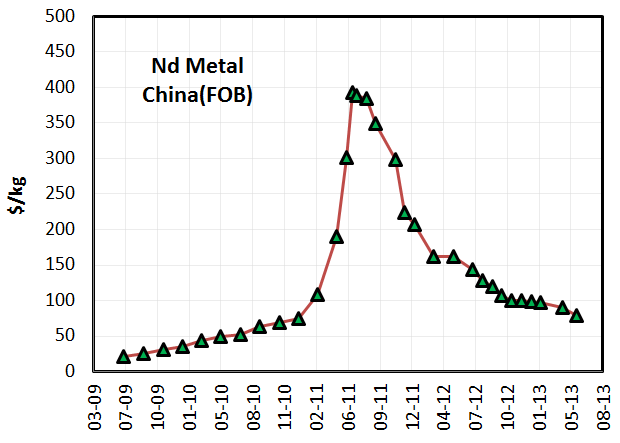
Rare earth metals’ prices continue to fall:                                                           Prices for Neodymium and Dysprosium in May 2013

May 25, 2013


Picture

Picture

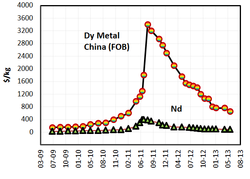
According to the website of    http://www.metal-pages.com, the prices of rare earth metals continue to fall. In this week, the neodymium price is about $79/kg, which is at the level of February 2011; and the dysprosium price is about $660/kg, which is at the level of April 2011.

Rare earth weekly roundup – prices for heavy rare earths fall on dull demand
BEIJING (Metal-Pages) 24-May-13.  
This week, prices for medium and heavy rare earths have fallen in response to stagnant downstream demand. And the price fall has further postponed downstream demand with most buyers still…(Read more)
<<Previous
>>Forward

Archives

  • March 2023
  • June 2021
  • November 2019
  • August 2018
  • April 2018
  • March 2018
  • December 2017
  • November 2017
  • October 2017
  • August 2017
  • November 2016
  • August 2016
  • February 2016
  • June 2015
  • April 2015
  • February 2015
  • January 2015
  • December 2014
  • November 2014
  • October 2014
  • August 2014
  • May 2014
  • April 2014
  • March 2014
  • January 2014
  • November 2013
  • October 2013
  • August 2013
  • June 2013
  • May 2013
  • Rss Feed
All copyrights are reserved by Magnet Energy Corp, excepting the photos and contents which are credited to others. 
The contents of this website may be used when it is properly cited.